
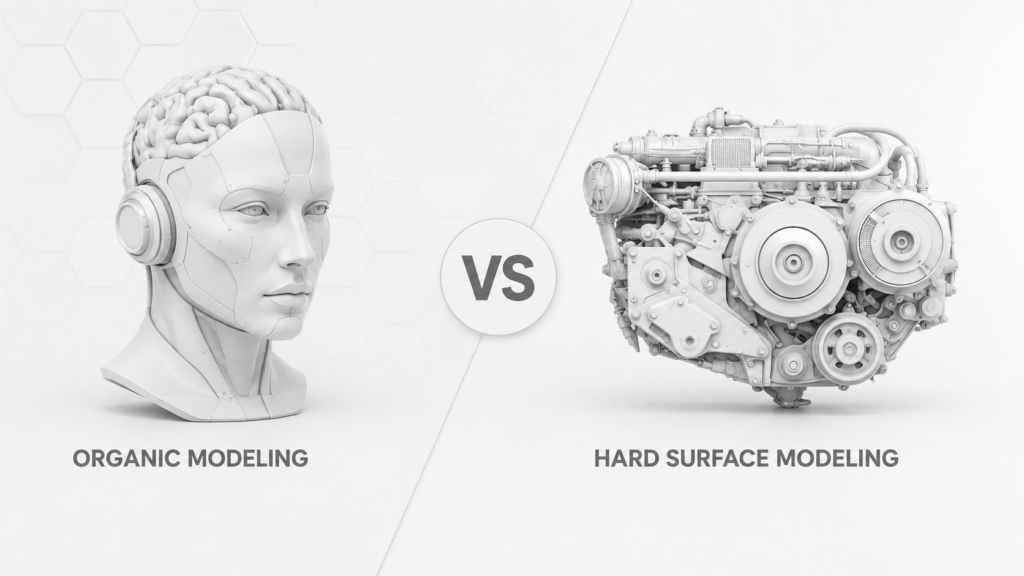
In the world of 3D modeling, every object you see in animated films, video games, architectural visualizations, and product designs is created using different techniques depending on the characteristics of the object. Broadly speaking, there are two primary modeling approaches that form the foundation of 3D asset creation: Hard Surface Modeling and Organic Modeling. Although both methods are used to create three-dimensional objects, they differ significantly in terms of workflow, techniques, and the skills required to master them. Understanding these two modeling approaches is essential for anyone pursuing a career as a 3D Artist.
By learning their differences, artists can choose the most appropriate workflow for a specific project while improving both efficiency and the quality of their final work.
Hard Surface Modeling
Hard Surface Modeling is a technique used to create man-made objects that feature rigid shapes, clean geometry, and precise structures. These objects are typically characterized by flat surfaces, straight edges, sharp corners, and dimensions that can be measured accurately. As a result, precision plays a critical role throughout the modeling process.
This technique is widely used across industries such as product design, industrial manufacturing, automotive design, furniture creation, consumer electronics, and architectural visualization. Whether modeling a modern chair, a smartphone, a sports car, or an office building, a 3D Artist must ensure that every proportion, dimension, and geometric detail closely matches the real-world object. Even a small mistake in bevels, edges, or proportions can significantly affect the realism and overall quality of the final render.
To achieve clean and production-ready models, Hard Surface artists rely on tools such as Extrude, Bevel, Chamfer, Inset, Boolean, and Modifier Stacks. Maintaining clean topology—primarily using quad polygons—is also considered an industry standard, as it allows models to be edited, animated, textured, and rendered more efficiently. Popular software for Hard Surface Modeling includes Autodesk 3ds Max, Blender, Autodesk Maya, Cinema 4D, and Fusion 360, all of which provide advanced tools for precision modeling.
Organic Modeling
Unlike Hard Surface Modeling, Organic Modeling focuses on creating objects inspired by nature or living organisms. These models typically feature smooth curves, flowing surfaces, soft transitions, and irregular shapes rather than perfectly straight lines or sharp edges. Organic Modeling is commonly used to create humans, animals, fantasy creatures, plants, and animated characters. Instead of emphasizing precise measurements, the focus is placed on anatomy, proportions, movement, and natural forms. As a result, this type of modeling demands not only technical skills but also a strong artistic understanding of shape and form.
The workflow often begins with a simple base mesh, which is then refined through digital sculpting to create muscles, facial expressions, wrinkles, skin details, and other fine features. Once the sculpt is complete, the model usually undergoes retopology to optimize the polygon count, making it suitable for animation, game engines, or high-quality rendering. The most widely used software for Organic Modeling includes ZBrush, Blender Sculpt Mode, Autodesk Mudbox, Nomad Sculpt, and 3DCoat. These applications are specifically designed for digital sculpting, allowing artists to work as if they were sculpting clay in the real world.
The Key Differences Between Hard Surface and Organic Modeling
The most significant difference between these two techniques lies in the type of objects they are designed to create and the approach used during production. Hard Surface Modeling emphasizes precision, clean geometry, and technical accuracy. It is ideal for objects with clearly defined shapes and engineered structures. Organic Modeling, on the other hand, prioritizes natural forms, anatomy, and artistic expression, making it the preferred choice for creating living creatures and organic environments.
Hard Surface models typically consist of straight edges, sharp corners, and flat surfaces, whereas Organic models are built with flowing curves, soft transitions, and irregular forms. From a workflow perspective, Hard Surface artists primarily use polygon modeling techniques, while Organic artists spend much of their time sculpting before optimizing the mesh through retopology. These differences also influence the skills required from a 3D Artist. Hard Surface Modeling demands exceptional attention to detail, precision, and an understanding of mechanical structures. Organic Modeling requires knowledge of anatomy, proportion, silhouette, and the artistic ability to create convincing natural forms.
Hard Surface Modeling and Organic Modeling are the two fundamental disciplines of the 3D industry, each serving a distinct purpose. Hard Surface Modeling focuses on creating precise, engineered, and man-made objects with clean geometry and technical accuracy. Organic Modeling, by contrast, is dedicated to producing natural, flexible, and lifelike forms that require artistic interpretation and anatomical understanding. For aspiring and professional 3D Artists alike, mastering both disciplines is a valuable investment. The ability to seamlessly transition between technical precision and artistic creativity opens doors to careers in product design, architectural visualization, animation, game development, visual effects, and film production. Ultimately, understanding the strengths of each modeling approach enables artists to select the most effective workflow for every project, resulting in high-quality, production-ready 3D assets that meet the standards of today’s creative industry.
Leave a Reply